Joint Pain & Arthritis
Knee Pain Exercises: Strengthening and Mobility Exercises to Try
Simple strengthening and mobility exercises for knee pain, with sets, reps, a sample weekly routine and when to stop.
By the physiotherapists at Spark Kinetics
·

Disclaimer: This article is for general information only and is not medical advice. Knee pain has many causes. Please check with a doctor or physiotherapist before starting knee pain exercises, especially after an injury or surgery, or if you have a diagnosed condition.
Quick Answer: What Are the Best Knee Pain Exercises?
The most common knee pain exercises are simple strengthening moves for the thigh, hip and calf muscles, plus gentle mobility work to keep the knee bending and straightening. These knee pain exercises build the muscles that take some of the strain off the joint.
Mobility: Heel slides, quad sets and gentle calf, quad and hamstring stretches
Strength: Straight-leg raises, half squats or sit-to-stands, step-ups, hamstring curls, calf raises and side-lying leg lifts
Typical dose: Around 10 reps per set, 2–3 sets, a few days a week
Pain rule: Mild discomfort that settles is usually okay; sharp or worsening pain means stop
Best results: Regular practice over weeks, ideally with a physiotherapist's plan
Why Do Knee Pain Exercises Help?
Knee pain exercises help because stronger muscles around the knee absorb shock and reduce stress on the joint, while mobility work keeps it moving freely.
The American Academy of Orthopaedic Surgeons (AAOS) explains that strong muscles help the knee joint absorb shock. Stretching those muscles helps restore range of motion.
The main muscles knee pain exercises target are the quadriceps (front of the thigh), hamstrings (back of the thigh), hip muscles like the glutes, and the calves.
For people with knee osteoarthritis, the UK's NICE guideline names therapeutic exercise as a core treatment. It recommends exercise tailored to each person, such as local muscle strengthening and general aerobic fitness.
Knee pain exercises will not "cure" the problem on their own. But done regularly, it can help ease pain and improve how well you move.
If you want to understand what might be causing your pain first, read our guide on knee pain physiotherapy, its causes, treatment and recovery. This post focuses only on knee pain exercises you can try.
How Should You Start Knee Pain Exercises Safely?
Start knee pain exercises with a 5–10 minute warm-up, choose just a few easy moves, and build up slowly over days and weeks. Move slowly and with control.
A few ground rules for knee pain exercises from NHS and AAOS guidance:
Warm up first. AAOS suggests 5–10 minutes of walking or a stationary bike.
Start small. NHS inform suggests starting with just 2–3 reps if you are new, then adding 1–2 reps every few days.
Go slow. Rushed reps use momentum, not muscle.
Rest between sets. About 30 seconds to a minute is common.
Take recovery days. One NHS trust plan suggests 3–4 sessions a week with a day off in between.
How Much Pain Is Okay?
A little discomfort can be normal, but exercise should not make your knee worse overall. Guidance differs slightly, so follow your physio's advice for your situation.
NHS inform uses a 0–10 pain scale for knee osteoarthritis. It suggests keeping pain during exercise at 5 or below. If it goes higher, do fewer reps, slow down or rest longer.
Pain after exercise should ease quickly. NHS inform says your pain should be no worse the morning after. One NHS trust leaflet says discomfort should settle within 2 hours.
The AAOS conditioning programme, which is aimed at recovery after injury or surgery, is stricter. It says you should not feel pain during an exercise.
Mobility Exercises for Knee Pain
Mobility exercises keep your knee bending and straightening fully. They are the gentlest knee pain exercises, and a good place to begin.
1. Heel Slides (Seated Knee Bend)
This move gently improves how far your knee bends.
How to do it:
Sit on a chair with your feet on the floor.
Slide one foot backwards along the floor, bending your knee as far as is comfortable.
Slide it back to the start.
Dose: 10 reps, 3 sets (NHS trust leaflet).
Tip: Put a towel or plastic bag under your foot on a smooth or carpeted floor so it slides easily.
2. Quad Sets (Knee Straightening)
This builds the thigh muscle and helps the knee straighten fully.
How to do it:
Sit or lie with your legs straight and heels resting on a rolled-up towel.
Tighten the front of your thigh and press the back of your knee down towards the floor.
Hold for 5 seconds, then relax.
Dose: 10 reps, 3 sets.
Common mistake: Holding your breath. Breathe normally throughout.
3. Gentle Stretches: Calf, Quad and Hamstring
Stretches loosen the muscles that pull on the knee. AAOS suggests doing them after a warm-up and again after strengthening.
Calf (heel cord) stretch: Face a wall, one leg forward and slightly bent, the other straight behind with the heel flat. Press your hips towards the wall. Hold 30 seconds, relax 30 seconds. AAOS: 2 sets of 4.
Standing quad stretch: Hold a chair, bend one knee and gently pull your heel towards your buttock. Hold 30–60 seconds. AAOS: 2–3 reps.
Lying hamstring stretch: Lie on your back, hold behind one thigh (or use a towel) and straighten the leg until you feel a stretch. Hold 30–60 seconds. AAOS: 2–3 reps.
Common mistake: Pulling on the knee joint itself in the hamstring stretch. Hold the thigh instead.
Strengthening Exercises for Knee Pain
Strengthening exercises build the thigh, hip and calf muscles that support the knee. These are the heart of most knee pain exercises plans.
4. Straight-Leg Raises
This works the front of your thigh without bending the knee, so it is often one of the first knee pain exercises a physio gives.
How to do it:
Lie on your back with one knee bent and that foot flat.
Keep the other leg straight, tighten the thigh and pull your toes towards you.
Slowly lift the straight leg about 30–40 cm, hold briefly, then lower with control.
Dose: 10 reps, 3 sets (NHS trust leaflets; AAOS also uses 3 sets of 10 with a 5-second hold).
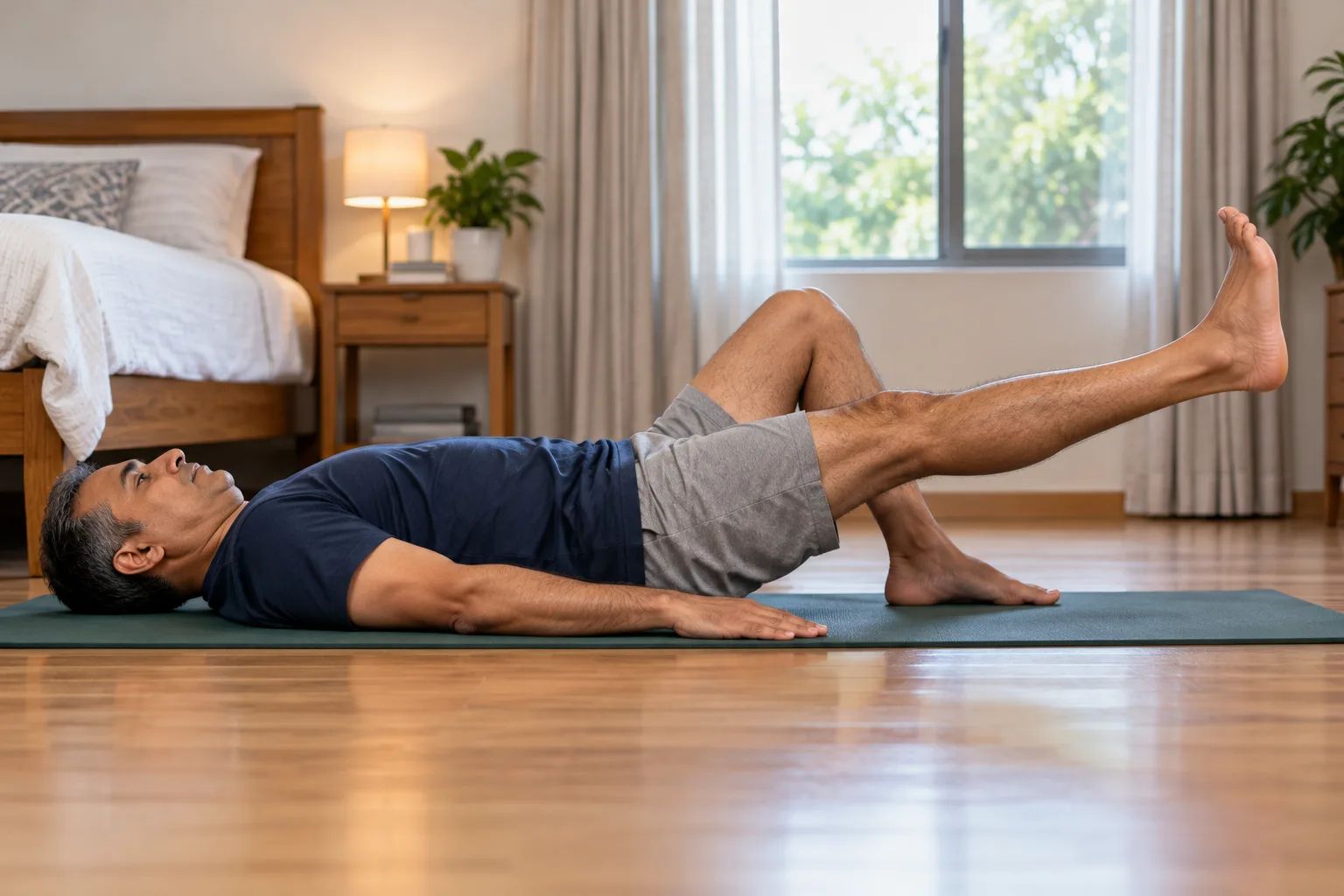
Common mistake: Letting the thigh relax so the knee bends. Keep it tight the whole time.
5. Sit-to-Stand and Half Squats
These are everyday-life knee pain exercises for the thighs and glutes.
Beginner (sit-to-stand): Sit near the edge of a firm chair, feet flat. Stand up without using your hands if you can, then sit down slowly.
Progression (half squat, AAOS):
Stand with feet shoulder-width apart, holding a chair if needed.
Keep your chest up and lower your hips about 10 inches (25 cm), as if sitting into a chair.
Hold 5 seconds, then push through your heels to stand.
Dose: AAOS: 3 sets of 10.
Common mistake: Bending forward at the waist. Keep your chest lifted.
6. Step-Ups
Step-ups are knee pain exercises that build strength for stairs and walking.
How to do it:
Step onto the bottom stair with one foot, then bring the other up.
Step down with the first foot, then the second.
Hold the banister if you need to.
Dose: Versus Arthritis suggests as many as you comfortably can, rest a minute, and repeat twice more.
Common mistake: Pushing off the bottom foot. Let the top leg do the work.
7. Standing Hamstring Curls
This strengthens the back of the thigh.
How to do it:
Hold a chair for balance.
Bend one knee, lifting your heel towards your buttock as far as you can without pain.
Hold 5 seconds, then lower.
Dose: AAOS: 3 sets of 10.
Tip: Keep your knees close together.
8. Calf Raises
Calf raises are simple knee pain exercises; strong calves help control the knee when you walk.
How to do it:
Stand holding a chair or wall.
Rise up onto your toes, then lower slowly.
To progress, lift one foot and do it on one leg, as AAOS describes.
Dose: AAOS: 2 sets of 10.
9. Side-Lying Leg Lifts (Hip Abduction)
Strong hip muscles help keep the knee in line when you walk and climb stairs.
How to do it:
Lie on your side, bottom knee bent for support.
Keep the top leg straight (not locked) and lift it to about 45 degrees.
Hold 5 seconds, lower slowly, rest 2 seconds.
Dose: AAOS goes up to 3 sets of 20. Beginners can start with far fewer and build up.
Common mistake: Rolling your leg or hips back to lift higher.
10. Seated Leg Extensions
This targets the front of the thigh in a seated position.
How to do it:
Sit up straight on a chair.
Tighten your thigh and slowly straighten one leg.
Hold 5 seconds, then lower your foot.
Dose: AAOS: 3 sets of 10.
Common mistake: Swinging the leg. Lift slowly and with control.
How Do You Progress Knee Pain Exercises?
Progress by adding a rep or two every few days, then adding sets, and only later adding light weight. Change one thing at a time.
A simple path:
Week 1–2: A few easy moves (quad sets, heel slides, straight-leg raises), small numbers of reps.
Week 3–4: Build towards 2–3 sets of 10. Add sit-to-stands, step-ups and calf raises.
Week 5–6: Try half squats, single-leg calf raises and light ankle weights if your physio agrees.
AAOS suggests adding hand or ankle weights starting at 5 lb (about 2 kg), up to 10 lb (about 4.5 kg), as moves get easier. NHS inform suggests aiming for a maximum of 2 sets of 15 for its osteoarthritis moves before progressing.

AAOS suggests following its programme for 4 to 6 weeks, then continuing 2–3 days a week to maintain strength.
Sample Weekly Routine for Knee Pain
This sample plan of knee pain exercises is an example only. Your physiotherapist can adjust it to suit your knee.
Day | Session (after a 5–10 min warm-up) |
|---|---|
Monday | Mobility + strength: heel slides, quad sets, straight-leg raises, sit-to-stand, calf raises, stretches |
Tuesday | Rest or a gentle walk |
Wednesday | Mobility + strength: heel slides, step-ups, hamstring curls, side-lying leg lifts, stretches |
Thursday | Rest or a gentle walk or cycle |
Friday | Mobility + strength: quad sets, half squats, leg extensions, calf raises, stretches |
Saturday | Light activity: walking, cycling or swimming |
Sunday | Rest |
Alongside knee pain exercises, gentle aerobic activity helps too. One NHS trust page suggests building up towards more than 150 minutes a week of walking, cycling or swimming at a pace where you can still talk.
Common Mistakes With Knee Pain Exercises
The most common mistakes are doing too much too soon, rushing reps and ignoring pain that keeps getting worse.
Skipping the warm-up. Cold muscles feel stiffer.
Going too fast. Slow reps build more strength.
Holding your breath. Breathe out as you lift.
Arching your back in stretches or squats.
Stopping after a week. NICE notes that long-term practice brings the most benefit.
Copying a plan made for someone else. Your knee may need different moves.
If you sit at a desk all day, stiffness can build up in more than just your knees. Our guide to neck pain exercises for desk workers has simple moves you can pair with your knee pain exercises.
If you also lift weights, our guide to shoulder pain after gym workouts explains how to train safely around a sore shoulder.
When Should You Stop Knee Pain Exercises?
Stop if an exercise causes sharp or new pain, or if your symptoms keep getting worse. Get medical help quickly for the red flags below.
Red Flags: Get Urgent Advice If
Based on NHS advice, get urgent medical help if:
Your knee is very painful
You cannot move your knee or put any weight on it
Your knee is badly swollen or has changed shape
Your knee locks, gives way or clicks painfully (painless clicking is normal)
You have a fever or feel hot, cold or shivery, with redness or heat around the knee, which can be a sign of infection
Also see a doctor if your knee pain does not improve within a few weeks.
Knee Pain Exercises With a Physio in Bangalore and India
A physiotherapist can check what is causing your knee pain and build a plan for you. NICE notes that supervised exercise may help people stick with it.
If you are in Bangalore or anywhere in India, search for a qualified physiotherapist near you, and ask about their training and experience with knee problems. Many clinics also offer home visits or online follow-ups.
Take this list of knee pain exercises along. Your physio can tell you which knee pain exercises to keep, change or skip.
Frequently Asked Questions
What are the best exercises for knee pain?
Quad sets, straight-leg raises, heel slides, sit-to-stands, step-ups, hamstring curls, calf raises and side-lying leg lifts are common starting points. The best mix depends on your cause of pain.
How many reps and sets of knee pain exercises should I do?
Many NHS and AAOS plans use about 10 reps for 2–3 sets. If you are new, start with just a few reps and build up slowly.
How often should I do knee exercises?
Many plans use 3–5 days a week with rest days in between. After 4–6 weeks, AAOS suggests 2–3 days a week to maintain strength.
Is it normal for knee pain exercises to hurt?
Mild discomfort that settles quickly can be normal, especially with osteoarthritis. Sharp, new or worsening pain is a sign to stop and get advice.
Can exercise cure knee pain?
No, knee pain exercises are not a guaranteed cure. But regular strengthening and mobility work can help reduce pain and improve movement for many people.
Should I do knee pain exercises if my knee is swollen?
If your knee is badly swollen, changed shape, or hot and red, get medical advice before exercising.
How long before knee exercises start to help?
It varies. Many structured programmes run for 4–6 weeks, and NICE says long-term practice brings the most benefit.
Do I need a physiotherapist for knee pain exercises?
It is a good idea, especially after an injury or surgery. A physio can tailor the moves and check your technique.
Sources: AAOS OrthoInfo – Knee Conditioning Program; NICE guideline NG226 (Osteoarthritis in over 16s) and quality standard QS87; NHS – Knee pain; NHS inform – Exercises for osteoarthritis of the knee; Wrightington, Wigan and Leigh NHS – Knee Exercises leaflet; Royal Orthopaedic Hospital NHS – Exercises for osteoarthritis of the knee; Northern Health and Social Care Trust – Knee osteoarthritis; Versus Arthritis – Knee pain booklet.
Book a physiotherapy session at Spark Kinetics
One-on-one physiotherapy in B Narayanapura, Mahadevapura. Call or WhatsApp us to book your assessment.
Book a consultation

